


AI in the music industry
As part of a YouTube-sponsored project at SMIX.LAB, current AI tools in music and the music business were researched, described according to use cases, and summarized in two toolboards.
AI Music Toolboard
The overview initially divides the tools into two main categories: music production (tools that support artists in music production or can be used in specific areas of music production) and functional music (tools that can generate complete pieces of music or pieces of music that are intended to have a specific effect or serve a specific purpose). The overview can also be filtered by use cases (see categories) and target groups.

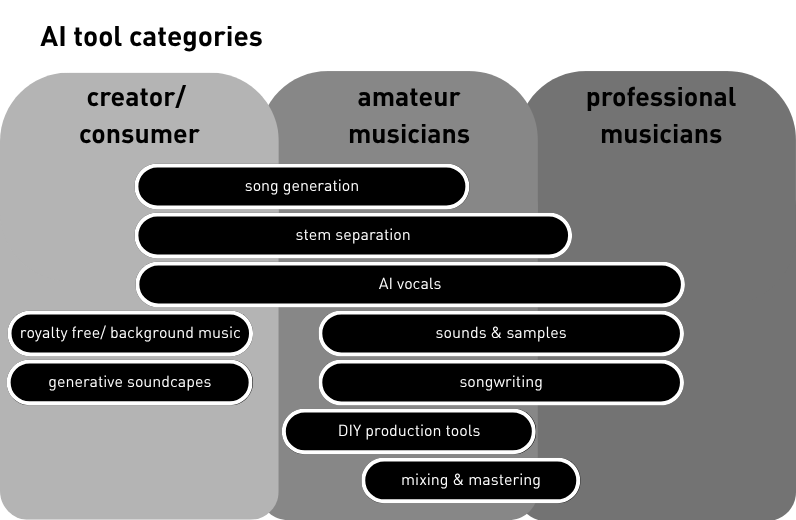
Music production
AI VOCALS
These tools make it possible to artificially generate or modify voices and voice patterns. For example, poor-quality voice recordings can be improved, or voice patterns can be adapted to other people using specially trained voice models.
SONGWRITING
In the field of songwriting, AI-supported tools are used to automatically generate melodies, chord progressions, and musical structures. These can be used in a co-creative process.
SOUNDS & SAMPLES
These tools analyze audio characteristics and suggest new samples or loops based on them. In addition, some tools allow you to generate individual sounds or complete sample packs on a prompt basis.
MIXING & MASTERING
These tools can be used to automatically adjust levels, optimize EQ settings, and improve sound quality.
STEM SEPARATION
These tools enable users to separate individual track components (stems) from each other. This allows voices or instruments to be heard in isolation, adjusted, or further processed.
Functional Music
SONG GENERATION
These tools can be used to generate complete music tracks in various genres with vocals/lyrics in different languages on a prompt basis. Some of the tools offer advanced editing options, such as stem separation, or the ability to have your own recordings processed.
GENERATIVE SOUNDSCAPES
These tools create individual soundscapes for meditation, relaxation, or focus, which can be customized to suit individual users and external influences such as weather or time of day.
DIY PRODUCTION TOOLS
These tools can be used to generate ideas in the early stages of musical composition. Some have additional functions, such as the ability to export MIDI notes.
ROYALTY FREE/ BACKGROUND MUSIC
As an alternative to music from production music libraries, these tools can be used to create individual short pieces of music or loops that can be used for advertising music or in the field of content creation, for example.
AI Music Business Toolboard
The Business Toolboard is divided according to various possible applications for AI in the music business. It describes different use cases for the supercategories marketing/communication, organization/strategy, and rights/licensing. You can also filter by the target groups management, label, publisher, and live. We are aware that we cannot cover all possible tools that are relevant to the music business. We have therefore decided on a selection to illustrate the various possible applications.
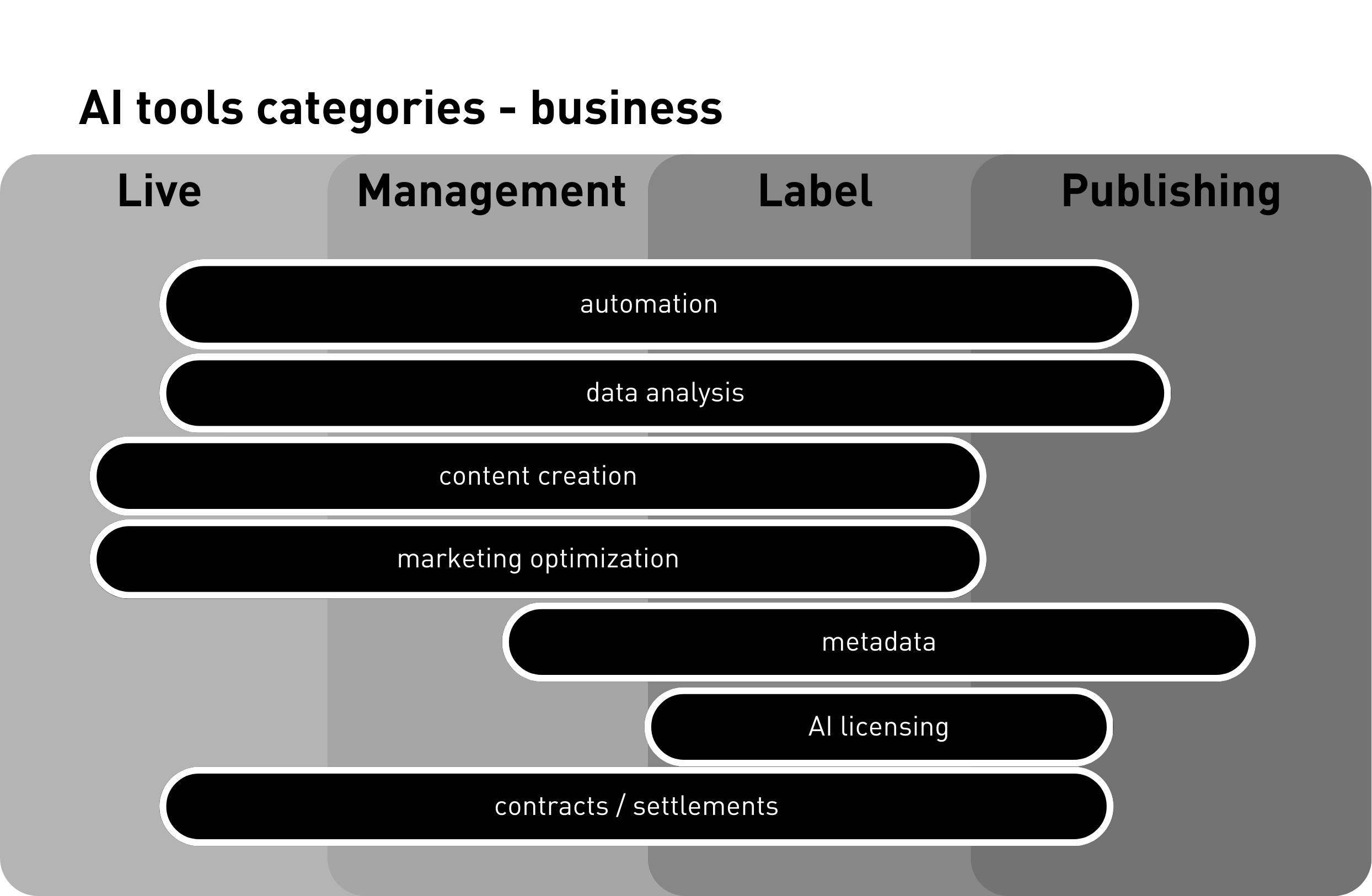
The various applications or possible uses are:
Marketing & Communication
Content creation
Tools in this area are used to create and edit text, image, video, and animation content. They also support the creation of brand identity and design elements, as well as the organization of production and publication processes.
Marketing optimization
These tools collect and analyze data on reach, interactions, and campaign performance. They support the planning or placement of advertisements, the management of communities (chatbot functions), and the administration of published content.
Organization & Planning
Data analysis
These tools use AI to process music, market, and usage data in order to identify patterns and trends. They are used for the structured evaluation and forecasting of developments in A&R, marketing, and sales.
Automation
Automated bundling and processing of data on dates, locations, contracts, communication, and finances for more efficient planning, management, and evaluation of live events, artist activities, and releases.
Rights & Licensing
Meta data
Tools for audio analysis, auto-tagging, and semantic search to consistently index large catalogs and make tracks easier to find for queries
KI Licensing
Tools for traceable attribution in generative music, as well as control and reporting for licensing and monetization of training and usage rights.
Contracts/ Settlements
Automated review and structuring of contract content, as well as support with billing
What to consider when using AI tools:The legal framework for the use of AI in the music industry is the subject of legal policy debates and has not yet been conclusively clarified—especially with regard to copyright, training data, and licenses. The Fairly Trained initiative advocates for the transparent, legally compliant, and ethically responsible use of AI training data. In our database, we have marked tools that have been proven to have been trained under fair conditions.We are aware that the use of generative AI models is associated with high resource consumption. Nevertheless, we consider it necessary to observe and classify current developments in the field of AI-supported tools, as they are already influencing creative processes, working methods, and business models in the music industry.